Flag pulling drills
Flag pulling is tackling for flag football, and it is the skill that wins youth games. Teach the breakdown, the near hand and the sideline before anything else on defense.
In your stats: Flag pulls. On every catch and run, the BreakAway app asks who pulled the flag. So each defender's pulls add up over every scrimmage and game.
Flag tag
A game of tag where the tag is a flag pull. It teaches young players to chase, reach and pull without ever grabbing a jersey.
- Ages 5-6
- Ages 7-8
- Ages 9-10
- Time
- 8 min
- Players
- 6 to 14
- Equipment
- 4 cones, a flag belt for every player
Setup
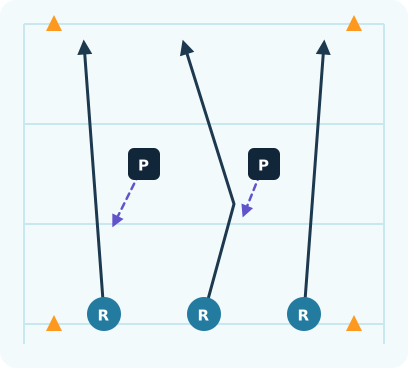
Mark a 15 by 15 yard box with four cones. Two or three pullers start in the middle; everyone else lines up on one side wearing flags.
Steps
- On the whistle, the runners try to cross to the far side without losing a flag.
- Pullers chase and pull. A runner who loses a flag becomes a puller.
- Runners who make it turn around and go again on the next whistle.
- Play until two or three runners are left, then reset with new pullers.
Coaching points
- Pull the flag, not the shirt or the belt. Hold the flag up after every pull so it counts.
- Shrink the box for 5 and 6 year olds so they catch someone early.
Mirror drill
A ball carrier tries to get past a defender in a narrow lane. The defender copies every move and pulls the flag.
- Ages 5-6
- Ages 7-8
- Ages 9-10
- Ages 11-12
- Ages 13-14
- High school
- Time
- 8 min
- Players
- Pairs
- Equipment
- 4 cones per pair, flag belts
Setup
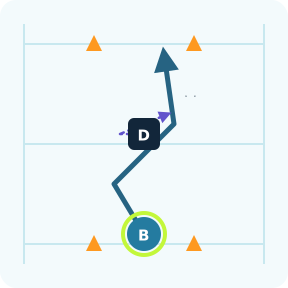
Make a lane 5 yards wide and 10 yards long with four cones. The ball carrier starts at one end, the defender 5 yards away facing her.
Steps
- The ball carrier jogs forward and uses fakes to get past.
- The defender shuffles to stay square, nose on the ball carrier's belly button.
- When the carrier commits, the defender pulls with the near hand.
- Swap roles after every rep. Five reps each.
Coaching points
- Eyes on the hips, not the head or the ball. Hips do not fake.
- Shuffle, do not cross your feet. Crossed feet get beaten by one cut.
- Keep it a jog for the youngest players; speed comes later.
Breakdown and pull
The defender sprints at a ball carrier. She chops her feet, gets low and pulls the flag as the carrier cuts. This is the most important defensive drill in flag football.
- Ages 5-6
- Ages 7-8
- Ages 9-10
- Ages 11-12
- Ages 13-14
- High school
- Time
- 8 min
- Players
- Two lines
- Equipment
- 4 cones, flag belts
Setup
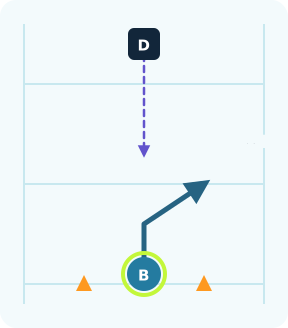
Two lines 12 yards apart, facing each other. Put two cones 6 yards wide at the ball carrier's end to keep the rep honest.
Steps
- The defender sprints toward the ball carrier.
- About 3 yards away, she chops her feet, sinks her hips and gets her hands ready.
- The ball carrier cuts left or right once.
- The defender steps with the cut and pulls with the near hand.
Coaching points
- Sprint, then sit. A defender who arrives at full speed overruns every cut.
- Near hand pulls, the far hand stays ready for the other flag.
- Do not dive. Diving is how flag games turn into collisions.
Sideline leverage
The defender takes an angle that pins the runner on the sideline. The line works like an extra defender.
- Ages 9-10
- Ages 11-12
- Ages 13-14
- High school
- Time
- 8 min
- Players
- Two lines
- Equipment
- 3 cones, flag belts
Setup
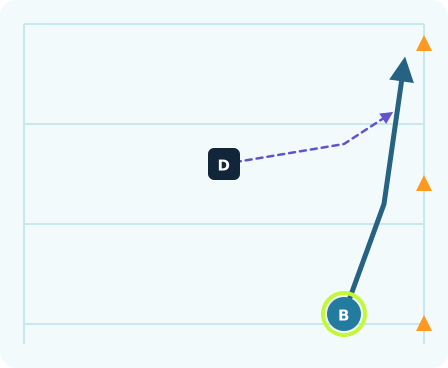
Use a real sideline. The ball carrier starts 4 yards in from it; the defender starts 8 yards downfield and 6 yards further inside.
Steps
- The ball carrier runs straight up the field near the sideline.
- The defender takes an angle to a spot in front of her, not where she is now.
- The defender keeps her outside shoulder in front, squeezing the carrier toward the line.
- Pull, or let the sideline finish it if she steps out.
Coaching points
- Aim where the runner will be. Chasing where she was is how the long touchdown happens.
- Inside-out: never let her cut back inside.
Route running and catching drills
Most flag football offense is a short throw to a receiver who is open on time. Clean cuts and soft hands matter more than speed.
In your stats: Receptions and receiving yards, from each completion logged. At Olympic Level the app adds targets, so you can see catches per target for every receiver.
Route tree walk-through
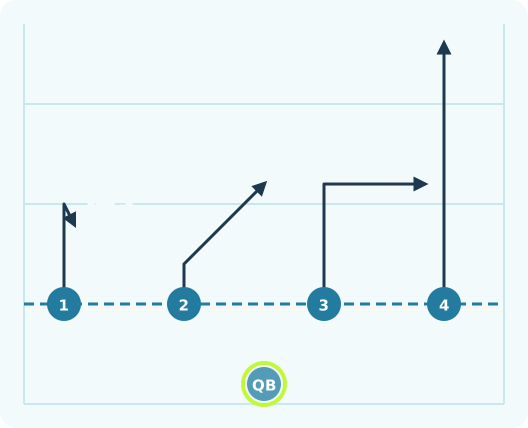
Every receiver learns the four routes most flag playbooks are built from: hitch, slant, out and go.
- Ages 7-8
- Ages 9-10
- Ages 11-12
- Ages 13-14
- High school
- Time
- 10 min
- Players
- 4 receivers at a time
- Equipment
- A ball, cones at 5 yards
Setup
Line receivers up across the line of scrimmage, each with a cone 5 yards downfield. A coach plays quarterback.
Steps
- Walk each route first, saying the depth and the cut out loud.
- Jog it, with the coach throwing on the break.
- Run it full speed. Rotate so every receiver runs every route from both sides.
Coaching points
- Five yards means five yards. A hitch at three is a different play.
- Head around fast on the hitch and the out. The ball should already be coming.
- Number the routes so a play call is one word or one number.
Cone cuts
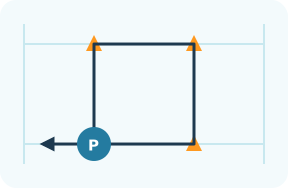
A square of cones teaches the 2 cuts every route uses. One is a sharp plant. The other is a rounded speed cut.
- Ages 5-6
- Ages 7-8
- Ages 9-10
- Ages 11-12
- Ages 13-14
- High school
- Time
- 6 min
- Players
- One line
- Equipment
- 4 cones
Setup
Set four cones in a 5 yard square. Players start at the bottom left cone.
Steps
- Sprint 5 yards to the first cone and plant on the outside foot to cut right.
- Sprint across to the next cone, plant and cut down.
- Sprint to the third cone and cut left, then finish through the start cone.
- Second time through, round the corners instead of planting, and feel the difference.
Coaching points
- Sink the hips before the plant. Tall players slip.
- Plant cuts beat man coverage. Speed cuts are for finding space against a zone.
Catch and tuck
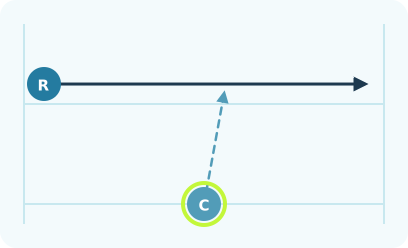
Receivers jog across the field and catch a soft throw, then tuck it away before they take another step.
- Ages 5-6
- Ages 7-8
- Ages 9-10
- Ages 11-12
- Ages 13-14
- High school
- Time
- 6 min
- Players
- One line
- Equipment
- A ball or two
Setup
A coach stands 6 yards in front of a line of receivers. They jog across in front of the coach, left to right.
Steps
- The receiver jogs across with hands ready at chest height.
- The coach throws a soft pass in front of her.
- She catches with her hands, not her body, then tucks the ball high and tight.
- Next receiver. Switch to running right to left after one round.
Coaching points
- Thumbs together for a ball above the chest, pinkies together below it.
- Eyes stay on the ball until it is tucked. Most drops happen while looking upfield.
Sideline catch
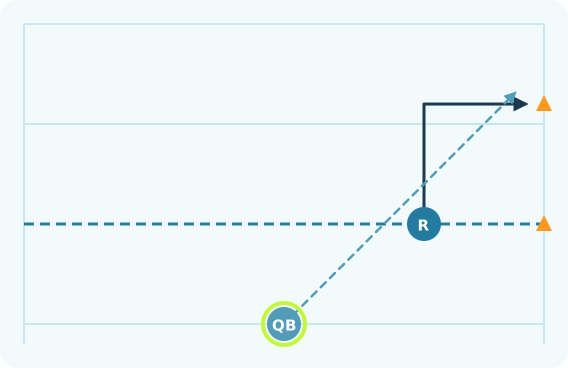
Receivers run an out route toward the sideline and make the catch with both feet in bounds.
- Ages 11-12
- Ages 13-14
- High school
- Time
- 8 min
- Players
- One line
- Equipment
- A ball, 2 cones
Setup
Receivers line up 6 yards inside the sideline. A coach stands in the middle and plays quarterback.
Steps
- Run 6 yards, plant and break toward the sideline.
- Catch the ball away from your body, at its highest point.
- Drag your toes or get both feet down before you step out.
Coaching points
- Throw it toward the sideline, where only the receiver can get it.
- Feet first, then celebrate. A catch out of bounds is an incomplete pass.
Quarterback drills
The quarterback touches the ball every snap. Grip, footwork and knowing where to look first are the three things to build, in that order.
In your stats: Catches, misses, passing yards, touchdowns and picks. They come from the Comp, Inc, TD and INT buttons.
One-knee throws
Partners throw to each other from 1 knee. With legs out of it, players can feel the grip, the elbow and the finish.
- Ages 5-6
- Ages 7-8
- Ages 9-10
- Ages 11-12
- Ages 13-14
- High school
- Time
- 6 min
- Players
- Pairs
- Equipment
- A ball per pair
Setup
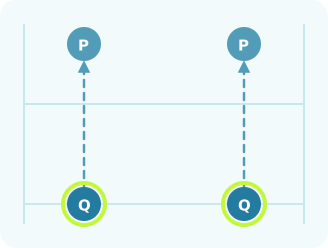
Partners kneel 6 to 8 yards apart, on the knee on the same side as their throwing arm.
Steps
- Fingers on the laces, a little air between the palm and the ball.
- Turn the shoulders to the target, elbow up at shoulder height.
- Throw and finish with the thumb pointing down.
- Ten throws each, then move back 2 yards.
Coaching points
- Small hands are fine. Hold the ball further toward the back tip.
- If the ball wobbles, check the elbow first. It is almost always low.
Drop and throw
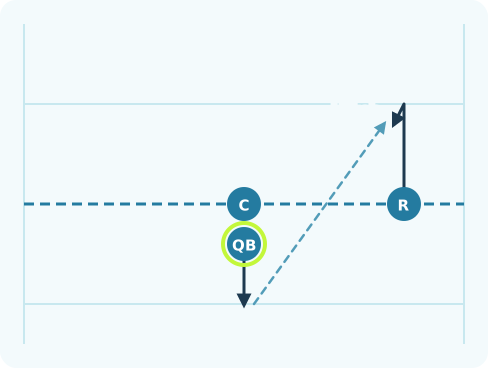
The quarterback takes the snap, drops three steps and throws on time to a receiver running a hitch.
- Ages 9-10
- Ages 11-12
- Ages 13-14
- High school
- Time
- 8 min
- Players
- Quarterbacks and a few receivers
- Equipment
- Balls, a center
Setup
A center snaps, the quarterback starts 2 yards behind her, and one receiver lines up wide.
Steps
- Take the snap and take three quick steps back, the last one short.
- Set the back foot as the receiver turns around at 5 yards.
- Throw on the receiver's turn, not after it.
- Rotate quarterbacks every five throws, then switch the receiver to the other side.
Coaching points
- The feet set the timing. A quarterback who drifts throws late every time.
- In shotgun, the same rhythm is catch, one step, throw.
Read 1, 2, 3
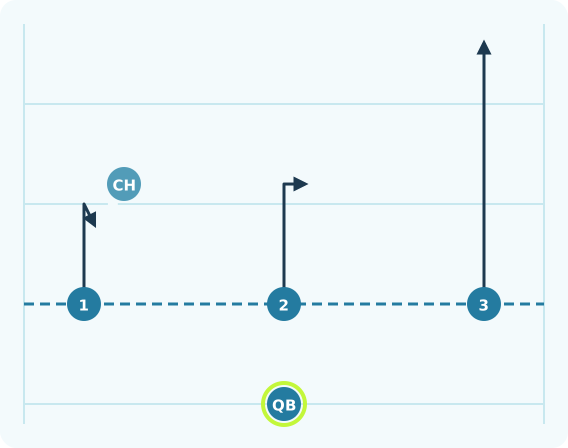
The quarterback learns to look at receivers in order. First, second, then third. She throws to the first one a coach leaves open.
- Ages 11-12
- Ages 13-14
- High school
- Time
- 10 min
- Players
- A quarterback, 3 receivers, a coach
- Equipment
- Balls
Setup
Three receivers run a hitch, a sit over the middle and a go. A coach stands in coverage and raises a hand at one receiver to show she is covered.
Steps
- Before the snap, the quarterback says her order out loud: one, two, three.
- On the snap she looks at receiver 1. If the coach is on him, she moves her eyes to 2.
- She throws to the first receiver who is open in her order.
- The coach changes who is covered every rep.
Coaching points
- Eyes move, then feet follow. Point the front foot at each read.
- If all three are covered, throw it away or run if your rules allow it. Do not force it.
Rollout throws
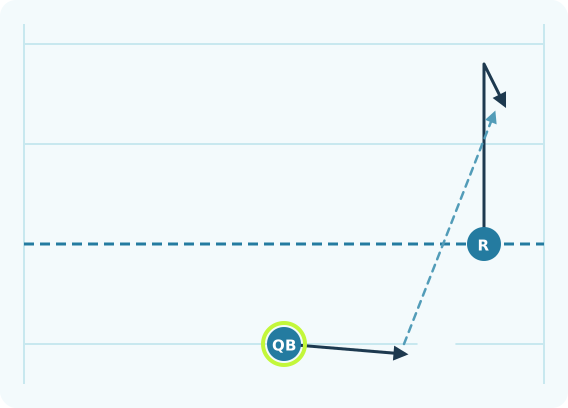
The quarterback rolls out to escape a rusher and throws on the move without stopping.
- Ages 11-12
- Ages 13-14
- High school
- Time
- 8 min
- Players
- Quarterbacks and receivers
- Equipment
- Balls
Setup
The quarterback starts in shotgun. One receiver runs a comeback near the sideline on the side she rolls to.
Steps
- Take the snap and roll toward the receiver, getting depth first and width second.
- Square the shoulders toward the target while still running.
- Throw and keep moving through the throw.
- Roll left as often as right, so a left-side rush is not a sack.
Coaching points
- Shoulders to the target, not the hips. The arm follows the shoulders.
- Throw high and outside on the run; a miss there is incomplete, not intercepted.
Center snap drills
In most flag formats the center snaps and then runs a route, so the snap has to be automatic. A bad snap is a lost down before the play starts.
In your stats: Bad snaps, logged from the Other sheet, so you can count them across a season. A center who releases into a route shows up in receptions like any receiver.
Snap and release
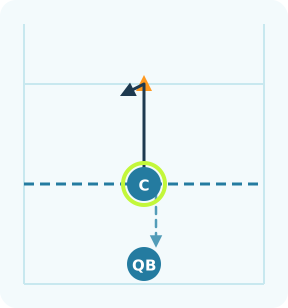
The center snaps to the quarterback, then runs straight into her route. In flag football the center can catch passes.
- Ages 5-6
- Ages 7-8
- Ages 9-10
- Ages 11-12
- Ages 13-14
- High school
- Time
- 6 min
- Players
- Center and quarterback pairs
- Equipment
- A ball per pair, a cone
Setup
Pairs line up: center over the ball, quarterback behind. Put a cone 5 yards downfield.
Steps
- The center grips the ball like a pass, laces up.
- Snap it back between the legs to the quarterback's chest.
- Step up and run to the cone, then turn around for the ball.
- Switch roles after five snaps.
Coaching points
- Snap first, run second. Leaving early is how snaps hit the ground.
- In formats with no snap at all, run this as a hand-off from the ground instead.
Shotgun snap target
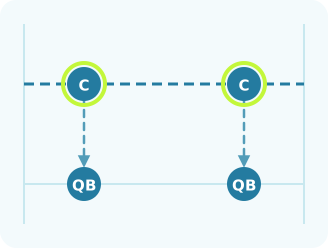
Centers snap to a quarterback in shotgun who holds her hands as a target at chest height. Count how many land in the target.
- Ages 7-8
- Ages 9-10
- Ages 11-12
- Ages 13-14
- High school
- Time
- 6 min
- Players
- Pairs
- Equipment
- A ball per pair
Setup
Quarterbacks stand 4 to 5 yards behind each center, hands out as a target.
Steps
- The quarterback shows her hands at chest height.
- The center looks back between her legs at the target, then snaps.
- Score it: 2 points in the hands, 1 point catchable, 0 on the ground.
- First pair to 15 wins, then swap.
Coaching points
- A spiral is nice. A catchable snap is required.
- Keep the distance the same as your game formation so the feel carries over.
Snap count
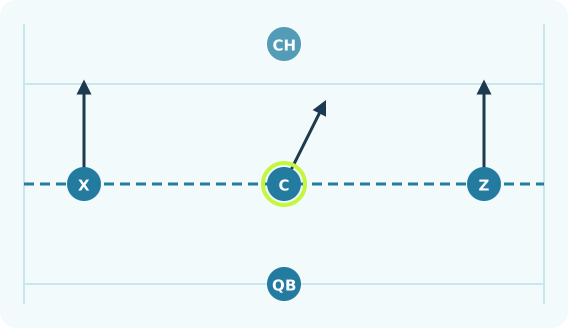
The whole offense lines up and only moves on the real snap, so false starts disappear before game day.
- Ages 5-6
- Ages 7-8
- Ages 9-10
- Ages 11-12
- Ages 13-14
- High school
- Time
- 5 min
- Players
- A full offense
- Equipment
- A ball
Setup
Line up a full offense. The coach stands downfield where everyone can see her.
Steps
- The quarterback calls the cadence: ready, set, and the snap word.
- Mix in a dummy count. Anyone who moves early does the rep again.
- On the real snap the receivers run 5 yards and stop.
Coaching points
- One snap word all season. Changing it mid-year is how a team gets flagged.
- Young teams can snap on the first sound. It is a choice, not a weakness.
Pass rush drills
The rusher starts from a set distance off the ball and goes for the quarterback's flag. Rush distance and how many players may rush depend on your ruleset.
In your stats: Sacks, logged from Other with the quarterback, who made the sack and where the ball ended up.
Rush lane
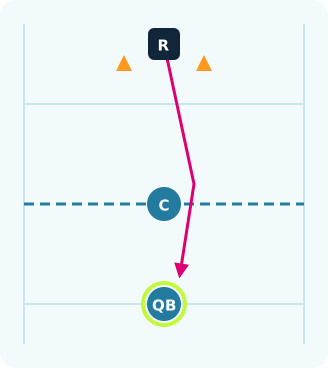
The rusher starts at the rush line and bursts out on the snap. She goes for the quarterback's flag with her hands up to bother the throw.
- Ages 9-10
- Ages 11-12
- Ages 13-14
- High school
- Time
- 6 min
- Players
- Rushers, a quarterback
- Equipment
- 2 cones, flag belts
Setup
Mark the rush line with two cones at the distance your ruleset sets. The quarterback stands in shotgun with a flag belt on.
Steps
- The rusher starts behind the rush line, on the snap only.
- Sprint at the quarterback's throwing shoulder, hands up as she gets close.
- Pull the flag, or get a hand in the throwing lane.
- The quarterback gets rid of the ball in a count of three, then swap.
Coaching points
- Rush lines and how many players may rush vary by ruleset. Check yours.
- Hands up, not out. Contact with the quarterback is a penalty, the flag is the target.
Contain rush
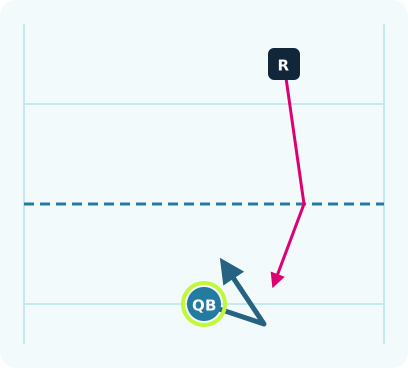
The rusher keeps the quarterback inside, not running past her. If the passer runs, she runs back into the defense.
- Ages 11-12
- Ages 13-14
- High school
- Time
- 6 min
- Players
- A rusher, a quarterback
- Equipment
- Flag belts
Setup
The rusher starts outside the quarterback's shoulder at the rush line. The quarterback tries to roll out to that side.
Steps
- On the snap, rush the outside shoulder, not the quarterback herself.
- When she rolls, stay outside and push her back to the middle.
- Pull the flag when she turns back in.
Coaching points
- Contain is a choice the coach makes. Against a quarterback who runs, it beats a straight rush.
- In rulesets where the quarterback cannot run, a straight rush is usually better.
Defensive drills
Pass defense in flag football is feet and eyes. Backpedal, read the quarterback, break on the ball and catch it at its highest point. Never touch the receiver.
In your stats: Interceptions and Pick 6s, plus flag pulls. At Olympic Level the app also logs pass breakups.
Backpedal and break
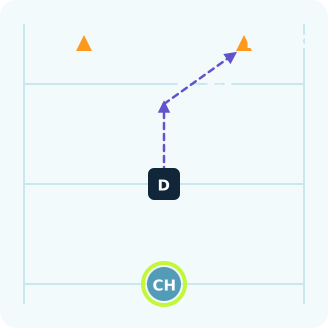
Defensive backs backpedal, read the coach's point, then plant and break on the angle to the ball.
- Ages 9-10
- Ages 11-12
- Ages 13-14
- High school
- Time
- 8 min
- Players
- One line
- Equipment
- 2 cones
Setup
Defenders start 5 yards off the coach. Two cones sit 12 yards deep, 4 yards either side.
Steps
- Backpedal with the weight over the toes and the eyes on the coach.
- When the coach points, plant the back foot and break toward that cone.
- The coach throws to the cone. Catch it at its highest point.
Coaching points
- Low pedal, short steps. A tall pedal cannot plant.
- Break on the quarterback's arm, not the receiver's head.
Zone drops
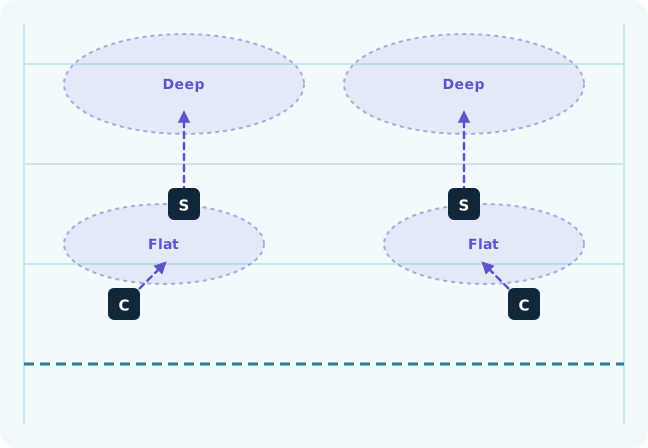
In a zone, each defender learns which part of the field is hers. She watches the quarterback from there.
- Ages 9-10
- Ages 11-12
- Ages 13-14
- High school
- Time
- 8 min
- Players
- 4 to 7 defenders
- Equipment
- Cones to mark each zone
Setup
Mark each zone with a cone: two deep halves and two short zones for 5v5, more for 7v7.
Steps
- Line up in the defense's start spots.
- On the snap, drop to your zone cone while watching the quarterback.
- The coach throws to a zone. The nearest defender breaks on it, the rest rally to the ball.
Coaching points
- Eyes on the quarterback. In zone you cover grass, not a person.
- Deep defenders stay deeper than the deepest receiver in their zone.
Hip pocket man coverage
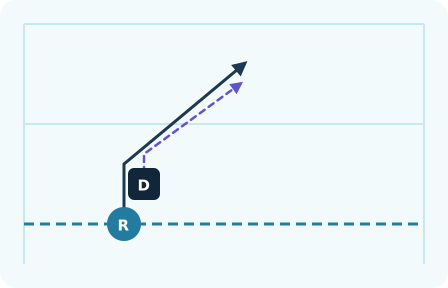
The defender stays right on the receiver's hip without touching her. When the receiver's hands go up, the defender plays the ball.
- Ages 11-12
- Ages 13-14
- High school
- Time
- 8 min
- Players
- Pairs
- Equipment
- A ball
Setup
A receiver and a defender face each other. The defender stands 1 yard inside and 2 yards back.
Steps
- The receiver runs a slant or an out at half speed.
- The defender stays a half step behind and inside, close enough to touch but not touching.
- When the receiver's eyes and hands go to the ball, the defender reaches through to the ball, not the body.
- Build to full speed over five reps.
Coaching points
- No hands on the receiver. Contact in coverage is a penalty in every flag ruleset.
- Look for the ball only when the receiver does. Turning early loses her.
High point interception
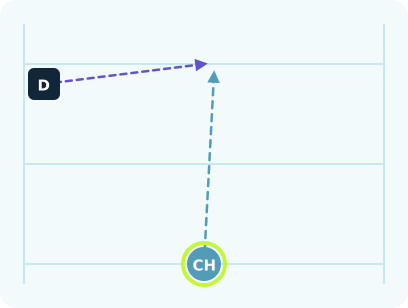
Defenders run to a spot and catch a high throw at the top of their jump. That is how picks happen.
- Ages 7-8
- Ages 9-10
- Ages 11-12
- Ages 13-14
- High school
- Time
- 6 min
- Players
- One line
- Equipment
- A ball
Setup
Defenders line up 8 yards to one side. The coach stands 10 yards away and throws to a spot between them.
Steps
- The defender runs toward the spot as the coach throws.
- She jumps and catches the ball with her hands at the highest point.
- Land, tuck and run back past the coach.
Coaching points
- Hands, not chest. A chest catch gets knocked loose.
- One defender at a time. No two players jumping for the same ball in this drill.
Conditioning and agility drills
Keep conditioning short and hide it inside games. Players who still have legs in the second half are the ones still pulling flags.
In your stats: Nothing directly, and that is the point: fresh legs show up in the second half of the box score.
Flag relay
A relay race where the baton is a flag. Conditioning that young players ask to do again.
- Ages 5-6
- Ages 7-8
- Ages 9-10
- Ages 11-12
- Ages 13-14
- High school
- Time
- 6 min
- Players
- Two or more teams
- Equipment
- Cones, a flag per team
Setup
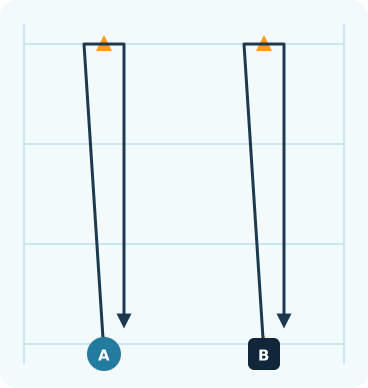
Teams line up behind a start cone with a turn cone 15 yards away.
Steps
- The first runner sprints around the turn cone and back.
- She hands the flag to the next runner, who cannot go until she has it.
- First team through wins. Add a backpedal or shuffle leg for older groups.
Coaching points
- Short races, lots of them. Conditioning that feels like a game gets effort.
- Mix teams every round so the same group does not lose every time.
5-10-5 shuttle
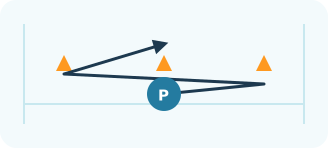
Sprint 5 yards one way, 10 back the other way and 5 to finish. It builds the change of direction every route and every flag pull uses.
- Ages 9-10
- Ages 11-12
- Ages 13-14
- High school
- Time
- 6 min
- Players
- One line
- Equipment
- 3 cones
Setup
Three cones in a line, 5 yards apart. The player starts at the middle cone.
Steps
- Sprint right to the first cone and touch the line with your hand.
- Sprint 10 yards back past the middle to the far cone and touch the line.
- Sprint 5 yards back through the middle cone.
Coaching points
- Stay low through the turns. Standing up to turn is where the time goes.
- Time it once a month. It is a number players like watching go down.
Red light, green light
The playground game, run carrying a football. Players learn to stop, start and keep the ball tucked while they do it.
- Ages 5-6
- Ages 7-8
- Time
- 6 min
- Players
- The whole team
- Equipment
- A ball per player if you have them
Setup
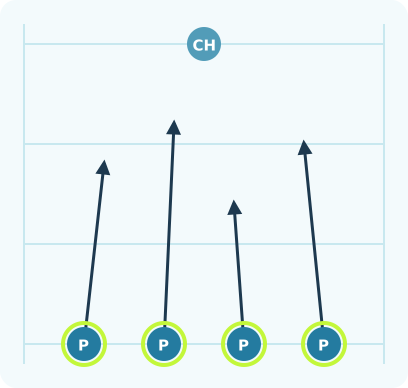
Players line up across the field, each holding a ball. The coach stands 15 yards away.
Steps
- Green light: run toward the coach with the ball tucked.
- Red light: freeze. Anyone still moving or with the ball loose goes back 5 yards.
- First to tag the coach is the next caller.
Coaching points
- Ball in the outside arm, high and tight, every time they stop.
- Add yellow light for a backpedal once they have it.
