
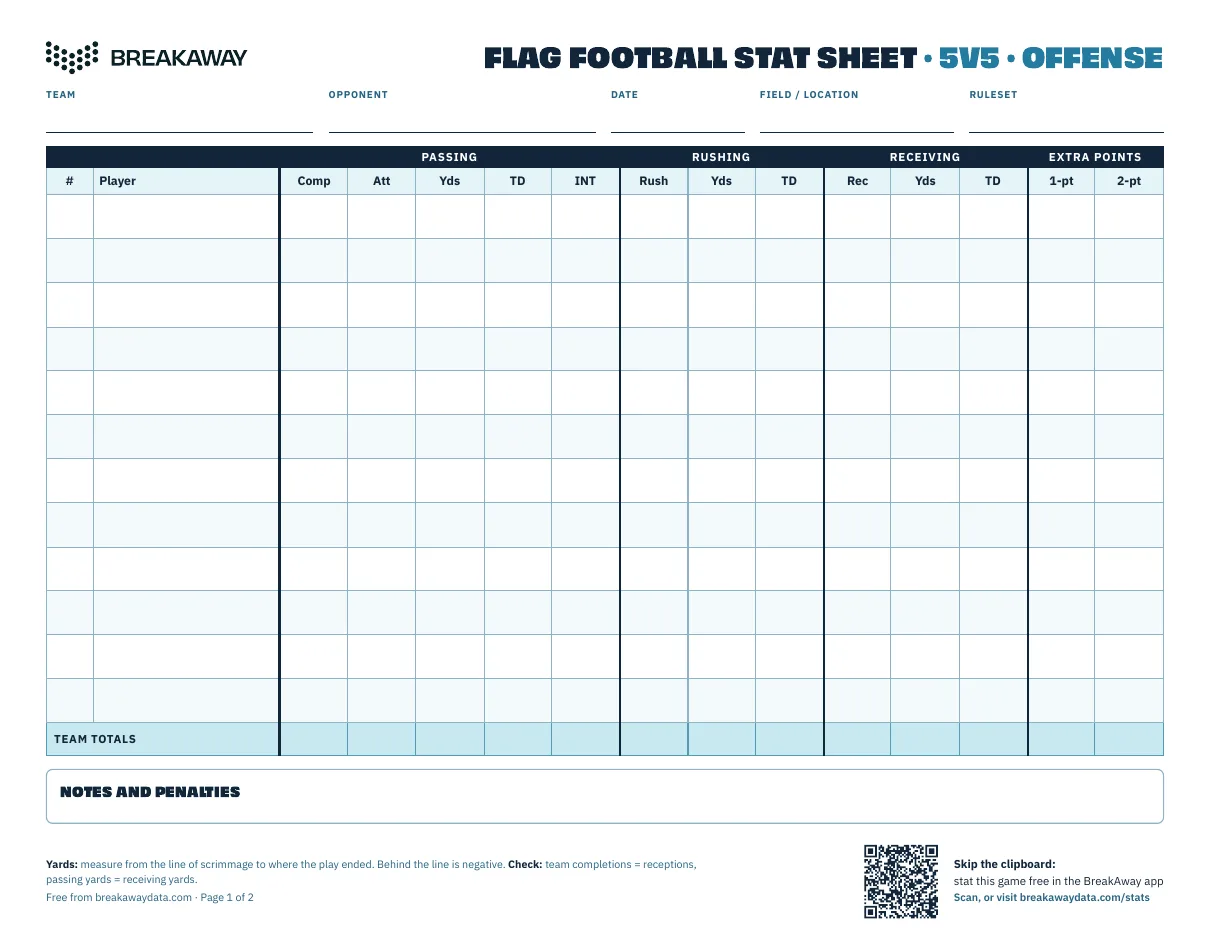
What is on the sheet
The same stats and the same names as the BreakAway app and our how-to-stat guide, so a season that starts on paper reads the same as one statted in the app. The sheet is ruleset-neutral: where a rulebook changes a stat, the sheet says so. See how the rules differ in our flag football rules comparison.
Page one: offense
- Completions (Comp)
- Forward passes caught by your own receiver.
- Pass attempts (Att)
- Every forward pass thrown: completions, incompletions and interceptions.
- Passing yards (Yds)
- On each completion, from the line of scrimmage to where the play ended.
- Passing touchdowns (TD)
- Touchdowns scored on the passer's completions.
- Interceptions thrown (INT)
- The passer's forward passes caught by the defense.
- Rushes (Rush)
- Running plays: the ball carried, not thrown forward.
- Rushing yards (Yds)
- From the line of scrimmage to where the carrier's flag was pulled or she went out.
- Rushing touchdowns (TD)
- Touchdowns scored by the ball carrier on a run.
- Receptions (Rec)
- Completed passes, counted for the receiver who caught them.
- Receiving yards (Yds)
- The same number as the passing yards on that completion, run after the catch included.
- Receiving touchdowns (TD)
- Touchdowns scored on a catch.
- 1-point tries good (1-pt)
- Successful tries after a touchdown worth 1 point.Depends on your ruleset: Try values and distances depend on your ruleset. Several 5v5 rulebooks take 1 point from the 5. The college rulebook takes it from the 3.
- 2-point tries good (2-pt)
- Successful tries after a touchdown worth 2 points.Depends on your ruleset: Most rulebooks in our comparison take 2 points from the 10. Check yours.
Page two: defense and the score
- Flag pulls (Flag pulls)
- Pulling the ball carrier's flag to end the play. One pull per play: there is no assist in flag.
- Sacks (Sacks)
- A flag pull on the quarterback, behind the line, while she still has the ball.Depends on your ruleset: Only where your ruleset lets defenders rush the passer, and from the distance it sets.
- Interceptions (INT)
- Forward passes caught by the defense.
- Pass breakups (PBU)
- Passes knocked away so they fall incomplete, without a catch. Optional.
- Interception return touchdowns (Pick-6)
- Interceptions returned all the way for a touchdown.
- Safeties (Safety)
- The offense's ball carrier made dead in its own end zone, usually by a flag pull there.Depends on your ruleset: Worth 2 points in most rulebooks we compared (1 on a try). Some formats have no safeties.
How to use the stat sheet
- 1.
Print one sheet per team
Two pages, letter size. Fill in the header before kickoff: the teams, the date, the field and your ruleset. The ruleset decides what tries are worth. It also decides whether anyone can rush the passer.
- 2.
Write the roster in first
Jersey number and name on every row, in the same order on both pages. Finding a player's row is the slowest part of paper statting. So do it before the first snap.
- 3.
Tally every play as it happens
Make a mark in the column for each completion, attempt, rush or catch. Write yards as a number. Measure from the line of scrimmage to where the play ended. A play stopped behind the line is negative.
- 4.
Credit the flag pull every time
Every completion and every rush ends with a flag pull, a step out of bounds or a score. Give the pull to one defender on page two. There is no assist in flag.
- 5.
Total the columns and check them
At the final whistle, add each column into the totals row. Two checks catch most mistakes. Team completions should equal team receptions. Passing yards should equal receiving yards.
Why paper loses stats
Paper works, and this sheet will get you through a game. But paper loses stats in the same places every time.
Plays come faster than pencils. In flag football the next snap is seconds away. The play you are still writing down is the one you miss. A missed flag pull never comes back.
Yards are math. Every completion and rush needs a spot and a subtraction. You do it in your head, on a sideline, while the next play starts.
The sheet ends at the final whistle. Somebody has to add it up, type it in and send it. Family who could not be there see nothing until they do. Most sheets never make it into a season record anyone can find again.