Flag football rules by ruleset
Flag football rules depend on the ruleset your league plays. Most rulebooks share a core. Pulling the ball carrier's flag ends the play. Contact is limited. A touchdown is worth 6. The try after it is worth 1 or 2 points, based on how far out you snap it. Players, field size, first downs, rushing and the clock change from one ruleset to the next.
Updated · 8 rulesets, 21 rules, cited to the official rulebooks
What are the five basic rules of flag football?
Most rulebooks share these five rules. Here is where they differ.
- Five or seven a side5v5 in NFL FLAG, USA Flag 5's and IFAF. 7v7 in USA Flag 7's, college and high school.
- Contact is limitedNFL FLAG and USA Flag ban blocking. IFAF is non-contact. College allows a screen block if the blocker does not start contact.
- Don't guard your flagsYou cannot stop a flag pull with your hands, arms or the ball. Most books make it 5 yards plus loss of down. High school makes it 10 yards.
- Rushers start 7 yards backNFL FLAG, USA Flag and IFAF rush from 7 yards back. The quarterback gets 7 seconds. College has no rush line.
- Touchdown 6, extra point 1 or 2NFL FLAG, USA Flag and IFAF try for 1 from the 5 or 2 from the 10. College and high school use the 3 and the 10.
What is not allowed in flag football?
Each rulebook sets its own penalty, but most rule these out.
- Blocking and screeningNFL FLAG and USA Flag ban it, and IFAF has no contact. College is the exception.
- Flag guardingNo stiff arms, no dropping a shoulder, and no covering your flags with your jersey.
- Jumping and hurdlingNFL FLAG bans jumping and hurdling. IFAF bans jumping and diving. College and high school penalize hurdling a player.
- A direct quarterback runNFL FLAG rules it out. USA Flag and IFAF let the quarterback run only after the ball comes back.
Pick a ruleset.Make it yours.
From 5v5 and 7v7 to NFL FLAG and your own house rules, if you play it, BreakAway can stat it.
Pick a preset
Start from a curated list of presets.
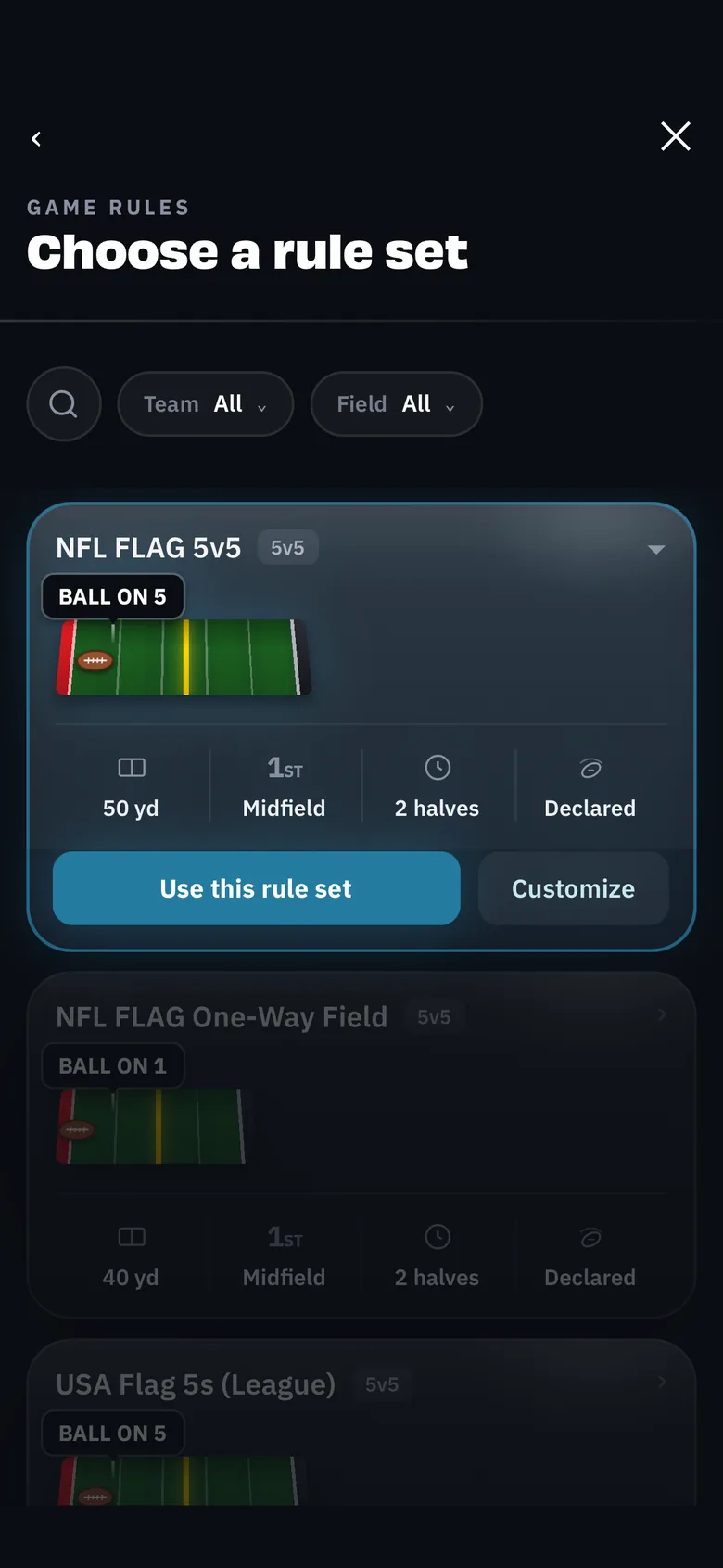
- NFL FLAG 5v55v5
- NFL FLAG One-Way Field5v5
- USA Flag 5s (League)5v5
- IFAF Flag Football5v5
- College Flag Football7v7
- Illinois HS Flag7v7
Tweak what's different
Change any rule for your team, league or tournament. Field and downs, how the game's organized, scoring, punts and turnovers, overtime. Saved to your team for the next game.
Stat every game
Tap to use it and you're ready to stat. Real stats, generated as you go.
100,000+ruleset combinations

The rules, ruleset by ruleset
Each column is one rulebook. Each box is that rule in plain words. The tag under it shows where to find it in the rulebook. A few boxes are blank, and they say why.
Show these rulebooks
Showing all 8 rulesets
| Rule | NFL FLAG 5v55v5 · Youth leagues and tournamentsStat this ruleset | NFL FLAG One-Way Field5v5 · Youth, on a one-direction fieldStat this ruleset | USA Flag 5's5v5 · Leagues and tournaments, all agesStat this ruleset | USA Flag 7's7v7 · Leagues and tournaments, all agesStat this ruleset | NFHS (girls' high school)7v7 · Sanctioned high schoolStat this ruleset | Illinois HS (IHSA)7v7 · Illinois girls' high schoolStat this ruleset | IFAF Flag Football5v5 · International playStat this ruleset | College Flag Football7v7 · College, including NAIA women'sStat this ruleset |
|---|---|---|---|---|---|---|---|---|
| Field and players | ||||||||
| Players on the field | 5 a side. The rulebook never states a count, but its rules talk about 5 eligible players. NFL FLAG's rules page allows up to 10 on a roster. | No One-Way change: the NFL FLAG 5v5 rule applies. | 5 to start. After an injury, a team may drop to 4. Never fewer. | 7 to start, with at least 7 on the roster. After an injury, a team may drop to 4. Never fewer. | 7 to start. Players may get hurt or thrown out with no one left to sub in. Only then may a team play short. Never below 5. | Follows NFHS. No Illinois adoption changes this. | Up to 5. Playing short is allowed. Missing 2 or more players is a forfeit. Rosters hold up to 15. | Up to 7. A team may play with fewer. |
| Field size | 30 x 70 yards. That includes two 10-yard end zones. The line to gain is at midfield. | The rulebook gives no size. Play runs one way: goal line to midfield to goal line. | 25 x 70 yards. That is a 50-yard field plus two 10-yard end zones. Smaller fields are allowed. | 25 x 70 yards, the same as the 5v5 book. That is a 50-yard field plus two 10-yard end zones. Smaller fields are allowed. | 4 sizes, and each state picks one. Goal lines are 80 or 100 yards apart. The field is 40 or 53 1/3 yards wide. End zones are 10 yards. The 80 x 53 1/3 size is new for 2026-27. NFHS 1-1-2; Table 1-7 #1NFHS diagrams #1 to #4NFHS changes 1-1-2 | 100 yards between the goal lines and 53 1/3 yards wide. That is NFHS field 3 (300 x 160 feet). State series hosts may use a field 45 to 53.5 yards wide. IHSA item 1NFHS diagrams #3IHSA manual host checklist, item 3 | A 50 x 25 yard field, plus 10-yard end zones. Countries may change it: 40 to 60 yards long and 20 to 30 wide. End zones must be at least 8 yards. | The goal lines sit 80 yards apart, with 10-yard end zones. Lines cross the field every 20 yards. The width is only shown in a drawing. |
| No-run zones | 2 on every drive: the 5 yards before midfield and the 5 yards before the goal line. No running plays across the line there. League play skips them for 8U and younger. | No One-Way change: the NFL FLAG 5v5 rule applies. | Just 1: the 5 yards before the goal line. Every play there must be a pass, even after a handoff. Leagues may drop it for beginners. | Just 1: the 5 yards before the goal line. Every play there must be a pass, even after a handoff. Leagues may drop it for beginners. | Not checked yet. This rule is in a part of the 2026-27 NFHS book we have not read. The book's penalty list has no no-run foul. | Follows NFHS. No Illinois adoption changes this. | The 5 yards in front of each goal line. If you snap on or inside the 5, you must throw a forward pass. Running there costs 5 yards and the down. | We found no no-run rule in this rulebook, so this is left blank. |
| Possession | ||||||||
| Starting the game | Coin toss, and the visitor calls it. The winner picks offense or defense. The loser picks the direction. The winner can't save its pick for later. Start at your own 5. No kickoff. | Every drive starts at the 40-yard line. | Coin toss, and the visitor calls it. The winner picks offense or defense. The loser picks the direction. Start at your own 5. | Coin toss, and the visitor calls it. The winner picks offense or defense. The loser picks the direction. Start at your own 5. | Coin toss, and the visitor calls it. It happens 3 minutes before the start, unless the state picks another time. The winner picks offense or defense, or a goal. It may save its pick for the 2nd half. No kickoff. Each half starts with a snap from the offense's 14. | The captains toss 10 minutes before kickoff. It may happen off the field before warm-ups. Everything else follows NFHS. | Coin toss, and the visitor calls it. The winner picks the half it gets the ball first. The other team picks the side. Drives start at your own 5. No kicks. | Coin toss, and the visitor calls it. The winner picks offense, defense or a goal, or saves its pick for the 2nd half. No kickoff. The first snap is at the offense's 14. |
| Downs and first downs | 4 downs to cross midfield. Then 3 downs to score. | No One-Way change: the NFL FLAG 5v5 rule applies. | 4 plays to cross midfield, then 4 to score. Midfield is the only first down. | 4 plays to cross midfield, then 4 to score. Midfield is the only first down. | 4 downs to get to the line to gain. It is the first 20- or 40-yard line ahead of the ball, set when the series starts. Near the goal, the goal line is the target. | Follows NFHS. No Illinois adoption changes this. | 4 downs. Midfield is the only line to gain. Crossing it earns a first down only once per drive. | 4 downs to reach the next line. Lines cross the field every 20 yards. No measuring with chains. |
| Turnover on downs | Short of midfield on 4th down, the other team takes over at that spot. Past midfield without a score, the other team starts at its own 5. | The ball never starts further back than the 40. | The other team starts at its own 5. That is true for every change of possession except an interception. | The other team starts at its own 5. That is true for every change of possession except an interception. | The other team gets the ball where the 4th down ended. | Follows NFHS. No Illinois adoption changes this. | The other team starts on its own 5. | The other team gets the ball. The rule does not say where. |
| Punts | No kicking. On 4th down (or 3rd) the coach calls punt or play. A punt gives the other team the ball at its own 5. | Once you call a punt, you can't change it. | We found no punt rule. If you don't cross midfield, the other team gets the ball at its own 5. | We found no punt rule. If you don't cross midfield, the other team gets the ball at its own 5. | Yes, a real punt. You must call it first. Then kick within 5 seconds of the snap. The other team can run it back, except on a try. Into the end zone, they start at their 14. Punting is on the list of state choices. Kicks off a tee or holder need state approval. NFHS 6-1-1, 6-1-2; 3-6-2b; 8-5-3, 8-5-4; Table 1-7 #20MPSSAA item 13 | Punts follow NFHS. Illinois allows no field goals and no kicking tee. | No. Kicking is not allowed at all. Kicking the ball on purpose costs 5 yards and the down. | Yes, a real punt. Tell the referee on 4th down, then kick within 4 seconds. No surprise punts. The other team can run it back. Into the end zone, they start at their 14. |
| Scoring | ||||||||
| Touchdown and extra point | Touchdown: 6. The try after it: 1 point from the 5 (pass only) or 2 from the 10 (run or pass). You call your choice. Changing it costs a timeout. | No One-Way change: the NFL FLAG 5v5 rule applies. | Touchdown: 6. The try after it is 1 point from the 5 or 2 from the 10. From the 5 it must be a pass, since that is the no-run zone. From the 10 you may run or pass. | Touchdown: 6. The try after it is 1 point from the 5 or 2 from the 10. From the 5 it must be a pass, since that is the no-run zone. From the 10 you may run or pass. | Touchdown: 6. On the try, you pick 1 point from the 3 or 2 from the 10. Field goals (3) and kicked tries (1) count only where the state allows them. Then the other team starts at its 14. A team still behind may keep the ball instead. It gets 4th down at its own 20. | Tries follow NFHS: 1 point from the 3 or 2 from the 10. No field goals. Overtime uses the same 2 tries. | Touchdown: 6. The try after it: 1 point from the 5 or 2 from the 10. You choose before the ref readies the ball. A snap on the 5 must be a pass. | Touchdown: 6. The try after it: 1 point from the 3 or 2 from the 10. Changing your choice costs a timeout. |
| Safety | 2 points. It happens when the ball carrier is downed in the end zone they defend. A snap that lands there counts too. The rulebook does not say how play restarts. | No safeties. The other team gets the ball at the 40. | 2 points, or 1 on a try. An offensive foul in its own end zone can be a safety. The other team then starts at its own 5. | 2 points, or 1 on a try. An offensive foul in its own end zone can be a safety. The other team then starts at its own 5. | 2 points. The team that gave it up then punts from its own 20. In 2025-26, the other team snapped from its own 30. Only the offense can score on a try. So there is no 1-point safety. | Follows NFHS. No Illinois adoption changes this. | 2 points, or 1 on a try. The team that scored it then snaps from its own 5. | 2 points, or 1 on a try. The defending team then takes over on its own 14. |
| Touchback | Not found in the rulebook, so this is left blank. | Not found in the rulebook, so this is left blank. | Not found in the rulebook, so this is left blank. | Not found in the rulebook, so this is left blank. | It happens 3 ways. A punt goes into the other team's end zone. A 3-point field goal misses. Or an interception ends in the catcher's own end zone. That team snaps from its own 14. | Follows NFHS. No Illinois adoption changes this. | The defense snaps from its own 5. That happens when the offense sends the ball dead into the end zone. It also happens on an interception near the goal line. The catch must be between the 5 and the goal line, with momentum carrying the player in. | The defending team takes over at its own 14. |
| Interceptions | Yes, you can run them back. A return touchdown is 6 during regular play. It is 2 on a try or in overtime. A backward pass behind the line can be picked off and run back too. NFL FLAG §VII.3; §XII.4NFL FLAG changes #4NFL FLAG rules page | The play ends at the catch. The ball goes to the 40. | Yes, you can run them back. The new offense starts where the play ends. A defensive touchdown on a try is 2. | Yes, you can run them back. The new offense starts where the play ends. A defensive touchdown on a try is 2. | Yes, you can run them back. The intercepting team starts where the play ends. On a try, the play stops once the defense has the ball. Only the offense can score on a try. | In overtime, an interception ends the play. No return. Otherwise NFHS. | Yes, you can run them back. The new offense starts where the play ends. A defensive touchdown on a try is 2. | Yes, you can run them back. The intercepting team starts where the play ends. A return for a score on a try is 2. |
| Plays | ||||||||
| Fumbles | The play ends where the ball hits the ground. | No One-Way change: the NFL FLAG 5v5 rule applies. | A ball that hits the ground ends the play. A bad snap is spotted where it landed. | A ball that hits the ground ends the play. A bad snap is spotted where it landed. | The play ends the moment the ball touches the ground. No one can scoop it up. A dropped pass or bobbled ball works the same way. So does a backward pass. A forward fumble that rolls out of bounds comes back to the fumble spot. | Follows NFHS. No Illinois adoption changes this. | The play ends once the ball touches the ground or a teammate touches it. The fumbling team keeps it there. If the player who fumbled, or an opponent, catches it first, play goes on. | A ball on the ground means the play is over. The fumbling team keeps it. If any player catches it first, play goes on. |
| Handoffs, laterals and forward passes | Handoffs, pitches and laterals only behind the line. One forward pass. It must start behind the line and cross it. The quarterback can't run with the snap. No center sneak. | No One-Way change: the NFL FLAG 5v5 rule applies. | Any number of handoffs and backward passes, all behind the line. The quarterback can't run unless the ball comes back to them. No center sneak. Throwing the ball away on purpose is a foul. | Any number of handoffs and backward passes, all behind the line. The quarterback can't run unless the ball comes back to them. No center sneak. Throwing the ball away on purpose is a foul. | Not fully checked. These rules are in a part of the book we have not read. The penalty list names 3 offensive fouls worth 5 yards and the down. They are a forward handoff, an illegal forward pass and throwing the ball away on purpose. | Follows NFHS. No Illinois adoption changes this. | Any number of handoffs behind the line. Backward passes only before the ball crosses it. One forward pass per down, from behind the line. The quarterback can't run past the line unless the ball comes back. | Backward handoffs and passes are allowed any time. One forward pass per down. It must be thrown from the line or behind it. |
| Rushing the passer and sacks | Up to 2 rushers, each with a hand raised. They start at the 7-yard rush line. Anyone may rush after a handoff or pitch. The passer has 7 seconds. A sack is pulling the quarterback's flag behind the line. No rushing in league play for 8U and younger. | No One-Way change: the NFL FLAG 5v5 rule applies. | Up to 2 blitzers, each 7 or more yards back with a hand raised. Anyone may rush after a handoff. The 7-second clock ends only on a handoff or pass. A sack is pulling the quarterback's flag behind the line. | Up to 2 blitzers, each 7 or more yards back with a hand raised. Anyone may rush after a handoff. The 7-second clock ends only on a handoff or pass. A sack is pulling the quarterback's flag behind the line. | Not fully checked. The rush rules are in a part of the book we have not read. The penalty list has no rush-line foul. Rushers must go for the flag. Hitting the QB's arm is roughing: 10 yards and a first down. | Follows NFHS. No Illinois adoption changes this. | Any defender more than 7 yards back may rush. Up to 2 may signal as blitzers and get the right of way. The rest wait for a handoff, fake handoff or pass. The passer has 7 seconds. | This rulebook has no rush line, no sack rule and no pass clock. Before the snap, defenders must stay back from the ball. Hitting the QB's throwing arm or hand is roughing. Penalty: 10 yards, plus a first down for the offense. |
| Flag guarding | It means blocking a flag pull. That covers a stiff arm, or dropping your shoulder, arm, hand, head or the ball in the way. A jersey over the flags counts too. Penalty: 5 yards and the down. | No One-Way change: the NFL FLAG 5v5 rule applies. | The same moves as NFL FLAG. Leaving your feet to dodge a flag pull counts too. Penalty: 5 yards and the down. | The same moves as the 5v5 book. That means a stiff arm, a dropped head or arm, a jersey over the flags, or leaving your feet. Penalty: 5 yards and the down. | Using the hands, arms or ball to stop a flag pull. It only counts if there is contact. Penalty: 10 yards. You keep the down. | Follows NFHS. No Illinois adoption changes this. | Covering your flags or reaching a hand toward the defender. Penalty: 5 yards and the down. | Using the hands, arms or ball to make contact that stops a flag pull. Penalty: 5 yards from the spot and the down. |
| Diving and jumping | No jumping, leaping or hurdling. The ball is spotted where you left the ground. Spins and jump cuts are fine. Defenders may dive to pull a flag or make a catch. | No One-Way change: the NFL FLAG 5v5 rule applies. | Leaving your feet to dodge a flag pull is flag guarding. That covers a dive, leap or jump. Avoiding a crash is the exception. Spins are fine unless out of control. Defenders may dive for a flag. | Leaving your feet to dodge a flag pull is flag guarding. That covers a dive, leap or jump. Avoiding a crash is the exception. Spins are fine unless out of control. Defenders may dive for a flag. | Hurdling a player costs 10 yards. If the defense does it, the offense also gets a first down. Hurdling has a new definition for 2026-27. A runner is down if a knee, hip or anything else besides a hand or foot hits the ground. | Follows NFHS. No Illinois adoption changes this. | No jumping or diving: 5 yards and the down. Dipping is fine. Spinning is fine unless your flags fly up. | Hurdling a standing player costs 10 yards. Diving into the end zone with no one near you is unsportsmanlike. |
| Blocking, screening and contact | No blocking or screening. No holding the ball carrier or running through them. | No One-Way change: the NFL FLAG 5v5 rule applies. | No blocking or screening: 10 yards and the down. The rulebook also explains shielding and aiming. | No blocking or screening: 10 yards and the down. The rulebook also explains shielding and aiming. | Not fully checked. The blocking rules are in a part of the book we have not read. The penalty list makes 4 blocking fouls 10 yards each. They are illegal technique, locked arms, holding and illegal use of hands. Screen blocking is a 2026-27 point of emphasis. | Follows NFHS. No Illinois adoption changes this. | No contact. Who had the spot first, or the path, decides who is at fault. Illegal contact costs 10 yards. The offense also loses the down. Against the defense, it is also a first down. | Screen blocking is legal if the screener does not start the contact. A defender's illegal use of hands costs 5 yards and gives a first down. |
| Pass interference | On the defense: the ball moves to where the foul happened, plus a first down. On the offense: 5 yards and the down. | No One-Way change: the NFL FLAG 5v5 rule applies. | On the defense: 10 yards from the line and a first down. On the offense: 10 yards and the down. | On the defense: 10 yards from the line and a first down. On the offense: 10 yards and the down. | 10 yards. No automatic first down. Most big defensive fouls give one, but not this one. | Follows NFHS. No Illinois adoption changes this. | 10 yards either way. Yards are marked off from the basic spot, the place the rules set for that kind of play. On the offense, it also costs the down. On the defense, it also gives a first down. It is the defender's job to avoid the receiver. | On the defense: a first down. Under 10 yards past where the play started, the ball goes to the foul. Otherwise it is 10 yards. On the offense: 10 yards from where the play started. |
| Clock and game | ||||||||
| Game length and clock | League: two halves of 15 to 25 minutes, set by the league. The clock stops only for injuries, halftime and timeouts. Each team gets one timeout per half, 60 seconds long. Play clock: 40 seconds. Tournament: two 12-minute halves on a running clock. Play clock: 25 seconds. Three 30-second timeouts a game. | No One-Way change: the NFL FLAG 5v5 rule applies. | League: two 20-minute halves. Play clock: 30 seconds. Each team gets 2 timeouts of 30 seconds per half. For 18 and over, stopping the clock in the last 2 minutes is suggested. Tournament: halves of 12, 15 or 20 minutes, by age. | League: two 20-minute halves. Play clock: 30 seconds. Each team gets 2 timeouts of 30 seconds per half. For 18 and over, stopping the clock in the last 2 minutes is suggested. Tournament: halves of 12, 15 or 20 minutes, by age. | Four quarters of 12 minutes, with a 1-minute break after the 1st and 3rd. Each state sets halftime between 5 and 20 minutes. You get 25 seconds to snap. Each team has 3 timeouts per half, 1 minute each, and loses any it doesn't use. Until the 2-minute mark of each half, an incomplete pass or a runner going out keeps the clock running. | 6-minute halftime. The clock runs, but stops for timeouts, injuries, scores, turnovers and penalties. In the final 2 minutes of each half, it also stops for out of bounds, incomplete passes and first downs. | Two 20-minute halves. The clock stops for set events in the final 2 minutes of each half. Play clock: 25 seconds. Two 60-second timeouts per half. | Four 12-minute quarters. The clock runs nonstop through minute 22 of each half. Then comes a two-minute timeout. Play clock: 30 seconds. 3 timeouts per half. |
| Overtime | Played in rounds. Round 1: one play each. Go for 1 from the 5 or 2 from the 10. Round 2: you must go for 2. Round 3 on: one play from your own 5, and most yards wins. An interception return is worth 2 and ends round 1 or 2. | No One-Way change: the NFL FLAG 5v5 rule applies. | League: each team gets a drive from midfield. Then come 1-point tries from the 5. Tournament: one play each. Go for 1 from the 5 or 2 from the 10. | League: each team gets a drive from midfield. Then come 1-point tries from the 5. Tournament: one play each. Go for 1 from the 5 or 2 from the 10. | The book has none. A state may pick a way to break ties. Overtime then counts as part of the 4th quarter. Unused 2nd-half timeouts don't carry into it. See the state table below. | One try each: 1 point from the 3 or 2 from the 10. The toss winner picks offense or defense first, or which end. The manual also sends ties to NFHS overtime rules. But the NFHS book has none. The 2025-26 adoptions add 2 rules. An interception ends the play. There is 1 timeout per team each period. IHSA manual Clock Procedures 8; VIII.DNFHS 3-1-1 NOTEIHSA item 13 | Each team gets one drive from midfield, with no first down there. Then come 1-point tries from the 5. No timeouts. | Each team gets a drive from the other team's 10. From the 3rd overtime on, each side gets a single try from the 3, worth 1 point. One timeout for all of overtime. |
| Mercy rule | League: the game ends at a 35-point lead. Tournament: 28. | No One-Way change: the NFL FLAG 5v5 rule applies. | The game ends at a 30-point lead, with no try. The league clock rule also says a 30-point lead means a running clock. | The game ends at a 30-point lead, with no try. The league clock rule also says a 30-point lead means a running clock. | The book has none. A state may set a lead that ends the game or starts a running clock. | A lead of 30 or more during the 3rd or 4th quarter starts a running clock. It runs for the rest of the game. It stops only for timeouts, quarter breaks and injuries. | No rule ends the game early. Lead by 30 or more when the two-minute notice comes, and the clock runs. That lasts for the rest of the half. | We found no mercy rule in this rulebook, so this is left blank. |
Scroll inside the table to see every rule and rulebook. Each tag jumps to its source below.
How states adjust NFHS rules
NFHS leaves 21 rules up to each state, from field size and punting to overtime. Here are the choices that change how a game is played. We cover each state whose 2026-27 choices we have read. Where a state says nothing, the NFHS rule applies.
Show these states
Showing all 4 states
| Rule | Illinois (IHSA)2025-26 adoptions, 2026-27 manual | North Carolina (NCHSAA)2026-27 | Tennessee (TSSAA)2026-27 | Maryland (MPSSAA)2026-27 |
|---|---|---|---|---|
| FieldNFHS Table 1-7 #1 | NFHS field 3: 100 yards between the goal lines, 53 1/3 wide. | NFHS field 1: 80 yards between the goal lines, 40 wide. | NFHS field 1: 80 yards between the goal lines, 40 wide. | NFHS field 1: 80 yards between the goal lines, 40 wide. |
| Flag beltsNFHS Table 1-7 #11 | 2 pop-up flags, one on each hip. Each flag is at least 15.5 by 1.5 inches. | A 3-flag belt is required. | Regular season: both teams wear the same kind of belt with the same number of flags. Postseason: a 3-flag belt. | 2 flags, one on each hip, are fine for 2026. A 3-flag belt is required from 2027. |
| Hash marksNFHS Table 1-7 #13 | Not yet. Illinois says it may be a year away. Every snap comes from the middle of the field. | Not on North Carolina's list, so the NFHS rule applies. Every snap comes from the middle of the field. | None. Every snap comes from the middle of the field. | No state rule. Officials follow NFHS, so every snap comes from the middle of the field. |
| PuntingNFHS option, MPSSAA list #13 | Not stated. Neither the 2025-26 Illinois list nor the 2026-27 manual mentions punting. | Not stated. Punting is not on North Carolina's list. | Not stated. Punting is not on Tennessee's list. | No state rule needed. Punts follow the NFHS kicking rules. |
| Field goals and kicked triesNFHS Table 1-7 #20 | None. No goal posts, no tee and no field goals. | Not adopted. Under NFHS, that means no field goals or kicked tries. | Not adopted. Under NFHS, that means no field goals or kicked tries. No kicking tee. | None. No goal posts, no tee, no field goals and no kicked tries. Punts follow NFHS. |
| Coin tossNFHS Table 1-7 #18 | 10 minutes before kickoff. It may happen off the field before warm-ups. | Not on North Carolina's list, so the NFHS rule applies: 3 minutes before the start. | The NFHS rule: 3 minutes before the start. | No state rule. The NFHS rule applies: 3 minutes before the start. |
| HalftimeNFHS Table 1-7 #17 | 6 minutes. Both coaches and tournament staff may agree to change it. | 10 minutes. Coaches may agree to shorten it. A longer one needs the state office's OK. | 10 minutes. Coaches may agree to shorten it. A longer one needs the state office's OK. | 10 minutes. Both teams may agree to cut it to 5 at the pregame meeting with officials. |
| OvertimeNFHS Table 1-7 #14 | One try each: 1 point from the 3 or 2 from the 10. The toss winner picks offense or defense first, or which end. The manual also sends ties to NFHS overtime rules, but the book has none. From the 2025-26 list: the visitor calls the toss. An interception ends the play. There is 1 timeout per team each period. IHSA manual Clock Procedures 8; VIII.DNFHS 3-1-1 NOTEIHSA item 13 | One try each: 1 point from the 3 or 2 from the 10. Both go toward the same goal. Repeat until someone wins. The visitor calls the toss. No timeouts, but 1 minute between periods. | One try each: 1 point from the 3 or 2 from the 10. Both go toward the same goal. Repeat until someone wins. The home team calls the toss. No timeouts, but 1 minute between periods. | Each team gets the ball at the 10, with 4 downs to score. After a touchdown, try from the 3 for 1 point or the 10 for 2. The defense may run back an interception or fumble for a touchdown. The visitor calls the toss. 1 timeout per period. Earlier timeouts don't carry over. |
| Mercy ruleNFHS Table 1-7 #15 | A lead of 30 or more during the 3rd or 4th quarter starts a running clock. It runs for the rest of the game. | If a team leads by 19 or more at the 4th quarter's two-minute timeout, the clock keeps running. Coaches may agree to end early. | If a team leads by 19 or more at the 4th quarter's two-minute timeout, the clock keeps running. Coaches may agree to end early. | A lead of 28 or more in the 2nd half starts a running clock. It stops only for injuries, timeouts and period ends. It also stops for a score that cuts the lead below 28. |
Scroll the table sideways for every state.
The NFHS cells answer one question each in our words, with the rule number. For the rules themselves, get the official NFHS rulebook.
Every rule, answered
Rules by question
- How many players are on a flag football team?
- Can the quarterback run in flag football?
- Rushing the passer: the rush line and the 7-second rule
- What is a no-run zone in flag football?
- Is flag football a contact sport? Blocking and contact rules
- What is flag guarding? The rule and the penalty
- Flag football field size and dimensions
- Flag football scoring: touchdowns, extra points and safeties
- How long is a flag football game?
- Can you jump, dive or spin in flag football?
- Flag football overtime rules
- Flag football mercy rule by ruleset
- How many downs in flag football?
- Interception rules in flag football
- Is there punting in flag football?
- Pass interference in flag football
- Fumbles, handoffs and laterals in flag football
- Flag football rule changes for 2026-27
- Flag football equipment rules
- Flag football age divisions and youth rules
- 5v5 flag football positions
- 7v7 flag football positions
Rules by rulebook
High school rules by state
Penalties
The rulesets and their rulebooks
NFL FLAG 5v5 rules
5v5 · Youth leagues and tournaments
The NFL FLAG rulebook covers league and tournament play. Each has its own clock and mercy rule. Every drive has 2 no-run zones: one before midfield and one before the goal line. Up to 2 rushers come from a 7-yard rush line. The field size and league half lengths come from NFL FLAG's rules web page. That page is newer than the rulebook and differs on both.
- NFL FLAG Official Playing Rules (Revised March 24, 2025)
- NFL FLAG Flag Football Rules (Web page, as of October 6, 2026)
- NFL FLAG Important Rule Changes (Effective fall 2024 league and tournament seasons)
- NFL FLAG Tournament Rules 2026-27 (2026-27)
NFL FLAG One-Way Field rules
5v5 · Youth, on a one-direction field
A version of NFL FLAG 5v5, from the same rulebook. Play runs one way, and every drive starts at the 40. There are no safeties. An interception ends the play at the catch. The ball never starts further back than the 40. Everything else follows the 5v5 rules.
- NFL FLAG Official Playing Rules (Revised March 24, 2025)
USA Flag 5's rules
5v5 · Leagues and tournaments, all ages
Midfield is the only first down. After a change of possession, the new offense starts at its own 5. The one exception is an interception. The only no-run zone is the 5 yards before the goal line. League and tournament play have their own clocks and overtime.
- USA Flag 5's Rulebook (v2026.2)
USA Flag 7's rules
7v7 · Leagues and tournaments, all ages
The 7-a-side version of the USA Flag rulebook. Apart from the number of players, it matches USA Flag 5's. The field is 25 x 70 yards. Midfield is the only first down. After a change of possession, the new offense starts at its own 5, unless it was an interception. The only no-run zone is in front of the goal line.
- USA Flag 7's Rulebook (v2026.2)
NFHS (girls' high school) rules
7v7 · Sanctioned high school
NFHS published its first flag football rulebook in 2025. It is for high school play, which today is mostly girls' flag football. This column follows the 2026-27 book. You get 4 downs to reach a line to gain on a 20- or 40-yard line. A try is 1 point from the 3 or 2 from the 10. A team still behind after its try may keep the ball. Each state picks the field size, overtime, the mercy rule and place kicking. See how states adjust NFHS rules, below. We have not checked the book's passing, rushing and blocking rules yet. Those cells say so.
- NFHS Flag Football Rules Book (2026-27)
- NFHS Flag Football Rules (Rules changes and points of emphasis)
- NFHS 2026-27 Flag Football Rules Changes (Final, May 2026)
- NFHS 2026-27 Flag Football Field Diagrams (2026-27)
- First NFHS Flag Football Rules Book now available (July 17, 2025)
- High school flag football revisions (February 18, 2026)
Illinois HS (IHSA) rules
7v7 · Illinois girls' high school
Illinois plays the NFHS rulebook with its own state choices. Its newest published list is from 2025-26. Where the 2026-27 IHSA manual differs, this table follows the manual. That covers the 30-point mercy rule, the coin toss 10 minutes before kickoff, the clock and overtime. Where Illinois changes nothing, the cell says it follows NFHS.
- IHSA Girls' Flag Football Manual for Schools and Managers (2026-27)
- IHSA adoptions for the 2025-26 NFHS Flag Football Rules (2025-26, Section 7)
IFAF Flag Football rules
5v5 · International play
The international rulebook, in effect since May 1, 2023. It is the newest IFAF edition we found. No contact is allowed. Midfield is the only line to gain, and there are no kicks at all. A 30-point lead at the two-minute notice runs the clock. It does not end the game.
- IFAF Flag Football Rules (2023, effective May 1, 2023)
College Flag Football rules
7v7 · College, including NAIA women's
The college rulebook. It covers two seasons: 2025-26 and 2026-27. A college rules committee writes it, and the NAIA hosts it. NAIA women's flag football plays it. It stands out in this table. The goal lines sit 80 yards apart, with lines every 20 yards. Games are four 12-minute quarters. It has a real punt and tries from the 3 or the 10.
- 2025-26 and 2026-27 College Flag Football Rules (2025-26 and 2026-27)
- NAIA 2026-27 Women's Flag Football Coaches Manual (2026-27)
Sources
- NFL FLAG Official Playing Rules (NFL FLAG, Revised March 24, 2025)
- NFL FLAG Flag Football Rules (NFL FLAG rules page, Web page, as of October 6, 2026)
- USA Flag 5's Rulebook (USA Flag 5's, v2026.2)
- USA Flag 7's Rulebook (USA Flag 7's, v2026.2)
- IFAF Flag Football Rules (IFAF, 2023, effective May 1, 2023)
- 2025-26 and 2026-27 College Flag Football Rules (College, 2025-26 and 2026-27)
- NFHS Flag Football Rules Book (NFHS, 2026-27)
- NFHS 2026-27 Flag Football Rules Changes (NFHS changes, Final, May 2026)
- IHSA adoptions for the 2025-26 NFHS Flag Football Rules (IHSA, 2025-26, Section 7)
- IHSA Girls' Flag Football Manual for Schools and Managers (IHSA manual, 2026-27)
- NFHS 2026-27 Flag Football Field Diagrams (NFHS diagrams, 2026-27)
- NFL FLAG Important Rule Changes (NFL FLAG changes, Effective fall 2024 league and tournament seasons)
- MPSSAA Girls' Flag State Association Adoptions (MPSSAA, 2026-27)
- High school flag football revisions (NFHS, Feb 2026, February 18, 2026)
- NFHS Flag Football Rules (NFHS rules page, Rules changes and points of emphasis)
- NCHSAA adoptions for the 2026-27 NFHS Flag Football Rules (NCHSAA, 2026-27, June 2026)
- TSSAA adoptions for the 2026-27 NFHS Flag Football Rules (TSSAA, 2026-27)
- NFL FLAG Tournament Rules 2026-27 (NFL FLAG tournament, 2026-27)
- First NFHS Flag Football Rules Book now available (NFHS, Jul 2025, July 17, 2025)
- NAIA 2026-27 Women's Flag Football Coaches Manual (NAIA manual, 2026-27)
Not in the table
NIRSA (college intramural): NIRSA sells its 22nd edition rulebook. We could not find a free copy to read. So it is left out of the table instead of guessed at.
Bring yourweirdest rules.
Every game you stat gets a live game center families can follow from anywhere. You also get a box score and a stat card for every athlete. Team leaderboards, season totals and recaps come with it.
Flag football rules questions.
It depends on the ruleset your league plays. Most rulebooks share a core. Pulling the ball carrier's flag ends the play, and contact is limited. A touchdown is worth 6. The try after it is worth 1 or 2 points, based on distance. Players, field size, first downs, rushing and the clock vary by ruleset.
5 a side in the 5v5 rulebooks: NFL FLAG, USA Flag 5's and IFAF. Up to 7 in the 7v7 ones: USA Flag 7's, college and NFHS high school. Some let you play short. Both USA Flag rulebooks let a team drop to 4 after an injury. NFHS lets a team with an empty bench play on with as few as 5.
Usually not. NFL FLAG and both USA Flag rulebooks ban blocking and screening. IFAF rules allow no contact. College is the exception. There, screen blocking is legal if the screener does not start the contact. NFHS made screen blocking a 2026-27 point of emphasis. Illegal blocking technique costs 10 yards there.
Only in small ways. Every rulebook here limits contact. Protecting your own flags is a foul, called flag guarding. It costs 5 yards and the down under NFL FLAG, USA Flag, IFAF and college rules. Under NFHS high school rules it costs 10 yards. Illegal contact under IFAF rules is 10 yards.
A touchdown is 6. The try after it is 1 or 2 points. NFL FLAG, USA Flag and IFAF take 1 from the 5 and 2 from the 10. College and NFHS take 1 from the 3 and 2 from the 10. A safety is 2 points in every rulebook that covers it. A defensive score on a try is worth 2 in most of them. NFHS lets only the offense score on a try.
The 5v5 rulebooks are NFL FLAG, USA Flag 5's and IFAF. They play 5 a side on a field 25 to 30 yards wide. It is 70 yards long: a 50-yard field plus two 10-yard end zones. Midfield is the line to gain. Each has a no-run zone in front of the goal line. Defenders rush the passer from 7 yards off the line.
Three rulebooks here play 7 a side: USA Flag 7's, college and NFHS high school. USA Flag 7's keeps the USA Flag 5's rules. It plays on a 25 x 70 yard field with two 20-minute league halves. College and NFHS play four 12-minute quarters. They take tries from the 3 or the 10 and use a called punt. College allows screen blocking if the screener does not start contact. NFHS offers 4 field sizes and leaves overtime to each state.
NFHS published its first flag football rulebook in 2025. It is for high school play, mostly girls' flag football. Under the 2026-27 book, teams start with 7 players. Games are four 12-minute quarters with 3 timeouts per half. You get 4 downs to reach a line to gain on a 20- or 40-yard line. A try is 1 point from the 3 or 2 from the 10. A team still behind after its try may keep the ball. Each state picks the field size, overtime, the mercy rule and place kicking.
The IFAF Flag Football Rules (2023) are 5 a side, with no contact. The field is 50 x 25 yards, plus 10-yard end zones. Midfield is the only line to gain. A no-run zone covers the 5 yards in front of each goal line. There are no kicks. A game is two 20-minute halves.
It depends on the ruleset. NFL FLAG league games are two halves of 15 to 25 minutes, set by the league. Tournament games are two 12-minute halves. USA Flag league games and IFAF games are two 20-minute halves. College and NFHS high school games are four 12-minute quarters.