How to Get Recruited for Women's College Flag Football (2026)
263 colleges field varsity women's flag football, 126 of them at levels that allow athletic scholarships, as of October 16, 2026.
To get recruited, put verified game stats and film in front of the coaches on your list, email them yourself from sophomore year on, and register with the eligibility center your level uses.
- varsity programs
- 263
- at levels that allow athletic aid
- 126
- club programs
- 125
- high school girls live within 100 miles of one
- 9 in 10
Last checked against each program and governing body.
Grade by grade.The recruiting timeline.
The contact rules on this timeline come from each governing body and change by level; the rest is what works in a sport this new. Starting late? Begin at your grade and do the earlier steps now.
9th grade
Freshman year
Play, keep your grades up and start the record.
- Play every game you can: high school, club or league. See where your state stands on girls' high school flag football.
- Stat every game. Statting is free in the BreakAway app, and every statted game adds to the verified stats on your athlete profile.
- Take core courses seriously. NCAA Division I and II certify the core courses you take from ninth grade on.
- Browse every program by level and state, and save the ones that fit.
10th grade
Sophomore year
Build your list and start writing to coaches.
- Register with the NCAA Eligibility Center if Division I or II is on your list, or the NAIA Eligibility Center for NAIA schools.
- Cut a first highlight reel from game film, and keep the full games too.
- Email the coaches on your list and fill out each program's recruiting questionnaire. You can write to any coach at any time; the rules limit what coaches send back.
- NCAA Division I: calls, texts and recruiting materials from June 15 after sophomore year.
- NCAA Division II: recruiting materials, calls and texts at any time. In-person off-campus contact and official visits after June 15 before junior year.
11th grade
Junior year
The busiest year: conversations, camps and visits.
- NCAA Division I: off-campus contact and official visits from August 1 of junior year.
- NCAA Division III: no recruiting calendars. In-person off-campus contact only after the player finishes sophomore year of high school.
- NAIA: no contact calendar.
- Turn on recruiting on your BreakAway profile and choose which colleges can see it.
- Go to the camps and showcases the programs on your list run or attend, and email each coach before you go.
- Send updates after big games: new stats, new film, your next events.
12th grade
Senior year
Decide, sign and finish eligible.
- Keep statting your senior season. Coaches still finish rosters late in a sport this new.
- Compare total cost, not only the athletic line. Where a level allows athletic aid, programs often combine it with academic and need-based aid.
- Get every aid offer in writing, and ask what it covers and for how long.
- Send your final transcript and finish your amateurism questions with your eligibility center.
After high school
Junior college, club and transfer
Not recruited yet is not the end of the road.
- Junior college: 35 NJCAA programs on the list, a two-year route to play now and transfer later. NJCAA flag football becomes a championship sport in 2027-28, with the first national championship in spring 2028.
- Club: 125 confirmed club programs. Any enrolled student can try out, and current varsity players in the sport cannot play.
- Moving between programs: ask the coach and the compliance office first. Under NAIA rules, coaches may not contact a player already practicing at another NAIA school.
- Keep statting whatever you play. A two-year college season or a club season adds to the same record.
Every level.Its aid and contact rules.
Aid and contact rules belong to the level, not the sport. Each row comes from the governing body's own rules and links them. A level that allows athletic aid does not promise it: each program sets what it funds, so ask every coach.
NCAA Division I
17 varsity
- Athletic aid: allowed
- Athletic aid is allowed, and no flag football equivalency limit is set. At schools under the House settlement, a 25-player roster limit replaces scholarship limits from 2027-28.
- When coaches can contact you
- Calls, texts and recruiting materials from June 15 after sophomore year. Off-campus contact and official visits from August 1 of junior year. Register with the NCAA Eligibility Center.
- Championship
- An NCAA Emerging Sport for Women since January 2026, with no NCAA championship yet. The divisions vote on one in January 2027, and the first is projected for spring 2028.
NCAA Division II
47 varsity
- Athletic aid: allowed
- Up to 10.0 equivalency scholarships per team, which a coach can split into partial awards.
- When coaches can contact you
- Recruiting materials, calls and texts at any time. In-person off-campus contact and official visits after June 15 before junior year. Register with the NCAA Eligibility Center.
- Championship
- An NCAA Emerging Sport for Women since January 2026, with no NCAA championship yet. The divisions vote on one in January 2027, and the first is projected for spring 2028.
NCAA Division III
72 varsity
- Athletic aid: none
- Division III schools do not offer athletic scholarships. Academic and need-based aid are open to athletes like any other student.
- When coaches can contact you
- No recruiting calendars. In-person off-campus contact only after the player finishes sophomore year of high school.
- Championship
- An NCAA Emerging Sport for Women since January 2026, with no NCAA championship yet. The divisions vote on one in January 2027, and the first is projected for spring 2028.
NAIA
62 varsity
- Athletic aid: allowed
- Athletic aid is allowed under NAIA rules. The handbook's per-sport aid table does not list women's flag football yet, so ask each school its limit.
- When coaches can contact you
- No contact calendar. Coaches may not contact a player already practicing at another NAIA school. First-time players need the NAIA Eligibility Center.
- Championship
- A championship sport from 2026-27, its 30th. The first national championship is in spring 2027, a 12-team bracket on May 5 to 8.
NJCAA (junior college)
35 varsity
- Athletic aid: varies
- Up to 15 scholarships per team. Division I colleges may cover tuition, fees, room, board and books, Division II colleges tuition, fees and books, and Division III colleges give no athletic aid.
- When coaches can contact you
- No flag football contact rules published yet. Ask each college's athletic department.
- Championship
- An emerging sport with an invitational since 2023. It becomes a championship sport in 2027-28, with the first national championship in spring 2028.
CCCAA (California community colleges)
18 varsity
- Athletic aid: none
- No athletic scholarships. Players can get federal and state aid, academic grants and any award open to every student. Aid may not be based on athletic skill or on playing.
- When coaches can contact you
- Coaches can recruit anywhere in California. They have fewer ways to reach players from other states. A player at another California community college can't be recruited while she goes there.
- Championship
- Women's flag football is an emerging sport from 2026-27, so there is no state title yet. It can become a title sport once 10 or more colleges have varsity teams for two years in a row. Games start in late January. Conference play ends four Saturdays before Memorial Day. A team can play up to 28 games.
USCAA (small colleges)
10 varsity
- Athletic aid: varies
- It depends on the college. USCAA Division I colleges may give athletic scholarships. Division II colleges give none, and any aid must be open to all students. Flag football is not a USCAA sport, so ask each college what it funds.
- When coaches can contact you
- USCAA colleges recruit athletes the same way they recruit any student. Tryouts are allowed. A college can't pay for a visit unless it does so for every student. Coaches can't recruit a player at another college without that school's release.
- Championship
- No USCAA championship. Women's flag football is not on its 2026-27 list of championship or emerging sports. To become an emerging sport, at least one in ten members must say they will play in a postseason event.
Other associations (NCCAA and others)
2 varsity
- Athletic aid: varies
- Set by each association and college. Ask each program what it offers.
- When coaches can contact you
- Set by each association. Ask each program.
- Championship
- No association championship yet. The CCCAA made women's flag football an emerging sport in 2026-27, and the USCAA does not list it as a championship or emerging sport. For other associations, ask each program.
Club (most play NIRSA)
125 clubs
- Athletic aid: none
- No athletic scholarships: NIRSA runs club and intramural play, outside varsity athletics. Players must be enrolled students, undergraduates at least half time.
- When coaches can contact you
- No recruiting rules. Any enrolled student can try out, and current varsity players in the sport cannot play.
- Championship
- NIRSA regional championships send winners to its national championships, which have a women's division. Its women's Club Flag League starts in 2027.
What coaches look for.And how to show it.
Verified metrics
Game stats. Numbers from real games, not a list typed into a form.
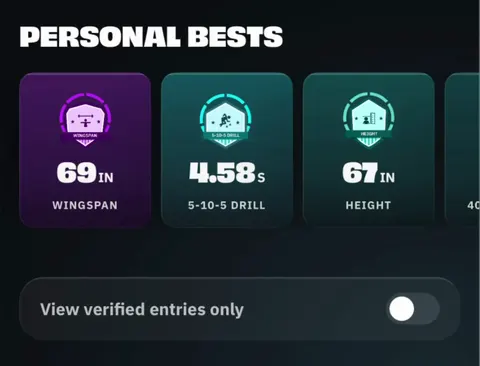
Athletic testing. Times and measurements that were measured, not typed in, and retested each year so a coach sees the trend.
On BreakAway: Every statted game lands on your Stats tab, captured live, play by play, by a named statter, and adds to your career totals. Combine results (5-10-5, 10-yard acceleration, 20-yard top speed, vertical, broad jump, height and wingspan) build personal bests and a progress chart on your Metrics tab, each marked Verified or Self entered.
How statting works →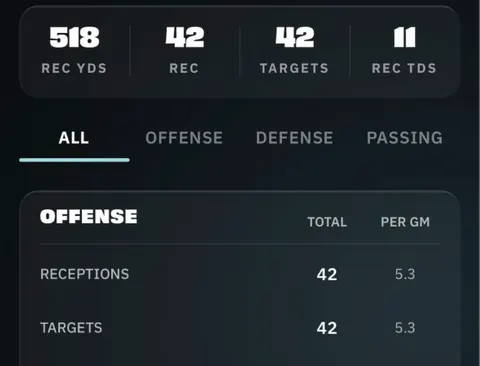
Customized profile
Academics. Your GPA and core courses decide whether you can play and how much academic aid you can earn.
Versatility. New programs build whole rosters at once, so a player who can line up in more than one spot is worth more.
On BreakAway: Your photo, your bio and every position you play, offense and defense, plus your graduation year, GPA, SAT or ACT scores and hometown under My Recruiting. Coaches filter prospects by position, class and minimum GPA, and you show up under every position you pick.
Edit your profile in the app →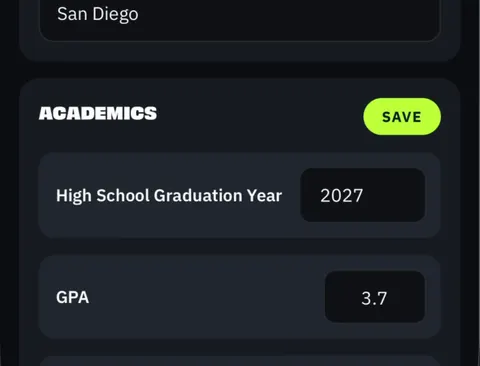
Recruiting options
Initiative. Most coaches in this sport recruit with small staffs and small budgets. The player who writes first, follows up and shows up at their camp is the one they remember.
On BreakAway: Tap Get Recruited and you are on the board in under a minute. Share with every program in one tap or pick them one by one, add or remove a program at any time, and pause with one switch. Share profile gives you the link for every coach email.
Get Recruited in the app →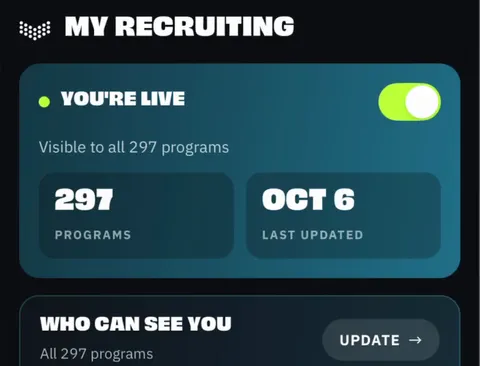
Rankings and leaderboards
Context. A number means more beside everyone else's. Coaches want to know where yours ranks among players they have never seen.
On BreakAway: Your Leaderboards tab ranks you on stat leaderboards, from receiving yards to flag pulls, and on metric leaderboards, with your place out of everyone ranked. Filter by age, gender, timeframe or verified only, and choose which boards show on your profile.
See your rank in the app →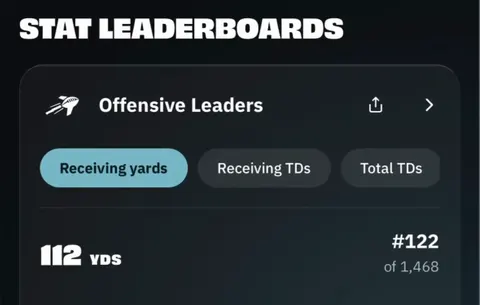
Eligibility centers
NCAA Division I and II programs need you certified by the NCAA Eligibility Center, and NAIA programs by the NAIA Eligibility Center. Division III schools and club teams admit you through their own process. Register in tenth grade so there is time to fix a missing course.
Find your programs.Every one is listed.
9 in 10 high school girls live within 100 miles of a college program. 7 in 10 high school girls live within 100 miles of a scholarship program. Start with every women's college flag football program, then narrow by level or state.
By state
- College programs: women's college flag football in that state
- High school status: where girls' high school flag football stands there
- Alabama
- Arizona
- Arkansas
- California
- Colorado
- Connecticut
- Delaware
- District of Columbia
- Florida
- Georgia
- Hawaii
- Idaho
- Illinois
- Indiana
- Iowa
- Kansas
- Kentucky
- Louisiana
- Maine
- Maryland
- Massachusetts
- Michigan
- Minnesota
- Mississippi
- Missouri
- Montana
- Nebraska
- Nevada
- New Hampshire
- New Jersey
- New Mexico
- New York
- North Carolina
- North Dakota
- Ohio
- Oklahoma
- Oregon
- Pennsylvania
- Rhode Island
- South Carolina
- South Dakota
- Tennessee
- Texas
- Utah
- Vermont
- Virginia
- West Virginia
- Wisconsin
Your record.Where coaches look.
Statting is free. Every statted game builds verified stats on your BreakAway athlete profile, which starts private: you turn on recruiting and choose which colleges can see it.
Get seenon BreakAway.
Where college coaches look
Coaches search players by verified numbers from statted games, then reach out.
How coaches recruit
Standings and leaders
Play a league on BreakAway and its public page lists every game, pool and stat leader.
For leagues & tournamentsStat every game
Statting is free. Tap the passer, the receiver and the flag pull, and the play is on her record.
How statting worksFollow every game
Family follows along from anywhere: the recap, the box score and her plays.
For families
Email a coach.Copy this and make it yours.
Start in tenth grade. You can write to any coach at any time; the rules limit what coaches send back, not what you send. Write before every camp or showcase you will attend, after big games, and whenever your film or stats change.
Six steps
Find the right coach
Open the program's athletics staff page and write to the head coach, copying the assistant who recruits your region if one is listed.
Write the subject line
Name, class, positions and city, so the coach can file it before opening it.
Lead with who you are
Put your class, positions, school and one reason you want that program in the first two lines.
Show your record
Add two or three verified stats, your profile link, a highlight reel, a full game and your GPA.
Ask one question and send it yourself
End with one question, and send it from your own email address so the coach writes back to you.
Follow up with news
No reply after two weeks is normal. Write again with something new: stats, film or your next event.
What to include
- Name, class, positions, school or club, and city in the first line
- One reason you want that program, so it reads as written for them
- Two or three verified stats, with the league and rules they came from
- Links, not attachments: your profile, a highlight reel and one full game
- GPA, and your eligibility center ID once you have one
- Your next games, and your coach's contact details
Subject: [First Last] | Class of [Year] | [Positions] | [City, State]
Hi Coach [Last name],

I'm [First Last], a Class of [Year] [positions] at [high school or club] in [City, State]. I'm interested in [College] because [one specific reason: a major, the conference, how your team plays].

This season: [two or three stats, with the league and rules we play].
My athlete profile with every statted game: [profile link]
Highlights: [film link]. Full game: [link]
GPA: [GPA]. Eligibility Center ID: [NCAA or NAIA ID, if registered]

My next games: [dates and events]. What do you look for in a [position], and should I fill out your recruiting questionnaire?

Thank you,
[First Last]
[Phone] | [Email]
My coach: [name, phone, email]
A subject line filled in for Sophia Johnson, a fictional player: Sophia Johnson | Class of 2028 | WR/DB | [City, State]
Tick it off.The recruiting checklist.
0 of 16 done
Get started
Build your record
Reach out
Decide
Your ticks stay in this browser only. Nothing is sent anywhere.
Recruiting questions.Straight answers.
They build a record, make a list of programs and write to the coaches themselves. Most college programs in this sport are new and recruit with small staffs, so the player who reaches out first is usually the one they see. Stat every game, keep film, and email coaches with your profile and highlights from sophomore year on.
Start your record in ninth grade and start writing to coaches in tenth. Freshman year is for playing, statting every game and taking the right core courses. Sophomore year is for a highlight reel, a list of programs and first emails. Junior year is the busiest, and seniors still find spots because new programs fill rosters late.
As of October 16, 2026, 126 of the 263 varsity programs play at levels that allow athletic aid: NCAA Division I, NCAA Division II and NAIA. Division III schools do not offer athletic scholarships. Club teams have none. A level that allows aid does not promise it, so ask each coach what the program funds and how it combines with academic aid.
It depends on the level. NCAA Division I: Calls, texts and recruiting materials from June 15 after sophomore year. Off-campus contact and official visits from August 1 of junior year. Division II: Recruiting materials, calls and texts at any time. In-person off-campus contact and official visits after June 15 before junior year. Division III: No recruiting calendars. In-person off-campus contact only after the player finishes sophomore year of high school. NAIA: No contact calendar.
Yes. The recruiting rules limit what coaches can send and when, not what you send. You can email any coach, fill out any questionnaire and visit any campus on your own at any time. A coach who cannot reply yet will still read it, and will remember the player who wrote first when the rules open.
Speed, change of direction, flag pulling, hands and good decisions, backed by numbers from real games. Coaches also weigh grades, because academics decide eligibility and academic aid, and versatility, because new programs fill whole rosters at once. Verified stats and film carry those traits to coaches who cannot see you play, which is why college coaches scout on BreakAway.
Yes, a short highlight reel plus at least one full game. Put your best plays first, mark yourself before each snap, include defense, and label every clip with the league, date and rules. Host it where a coach can watch it in one click, and pair it with verified stats so the coach sees the whole season, not only the best plays.
Yes, if you want to play at an NCAA Division I or II school or at an NAIA school. NCAA Division I and II programs use the NCAA Eligibility Center, even though flag football is an emerging sport, and NAIA programs use the NAIA Eligibility Center. Division III schools and club teams admit you through their own process. Registering in tenth grade leaves time to fix a missing course.
Your class, positions, school, GPA, verified game stats across seasons, a highlight reel and a full game. A BreakAway athlete profile holds every statted game, and you control who sees it: profiles start private, and you turn on recruiting and choose which colleges can see you. Put the profile link in every email you send a coach.
Yes, three ways. Ask varsity coaches about trying out once you enroll, look at the 35 NJCAA junior college programs, or join one of the 125 confirmed club programs, where any enrolled student can try out. Keep statting wherever you play, because a club or junior college season adds to the same record a coach reads later.
No. Flag football is played in several formats, and college associations, conferences and club leagues each pick their own rulebook and how many players are on the field. Coaches recruit athletes, not rulebooks. Label your film and stats with the rules they came from, and ask each program which rules it plays.
Play club, league or tournament flag football and stat those games, because coaches recruit from every kind of team. Check where your state stands, since more states sanction the sport each year, and build your list from programs in every region. Many college programs recruit nationally because the sport is so new.
Her numbers, on the record.
Stat her games free in the BreakAway app. Every game builds a verified stat line on her athlete profile, the record college coaches read when they scout.